The colour orange, recapping main shapes, the rhythm and rhyme in language (pre-reading skill)

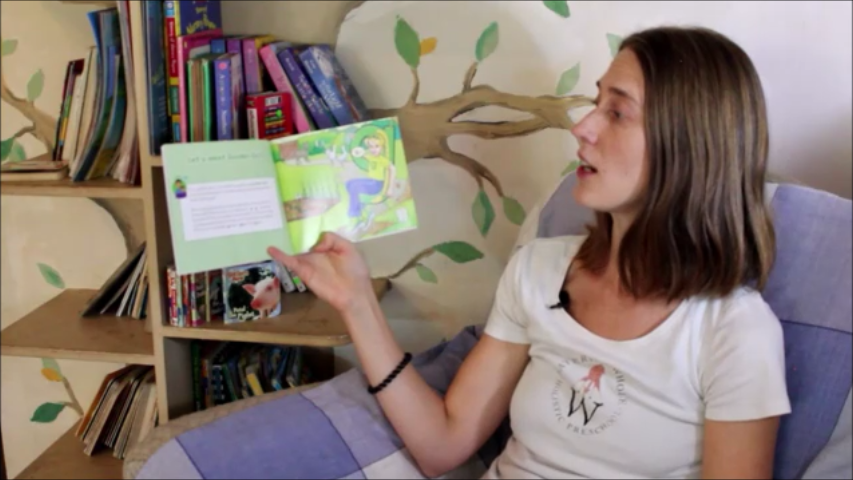


Learning points: help children to say the sound “g”, recognise the phonetic sound “g” in different words and help older children to recognise the visual formation of the letter “g”.
Did you know….identifying the sounds in a word is an important foundational skill needed for reading and writing? Sound identification always starts with identifying the first sound in a word, then later the last sound and finally the middle sound.
As we explore our African Alphabet together we are starting to help our children identify the first sound in words.
Do you know guinea fowl starts with the letter (sound) “g” and Go-Away bird? What other words begin with “g”. Let’s explore together….
*Side note – remember we are starting with learning phonetic sounds, so be careful to not include words like ‘Giraffe’ which actually phonetically sound more like a ‘J’, as this will confuse your little ones at this early stage.
Golden Girl Song:

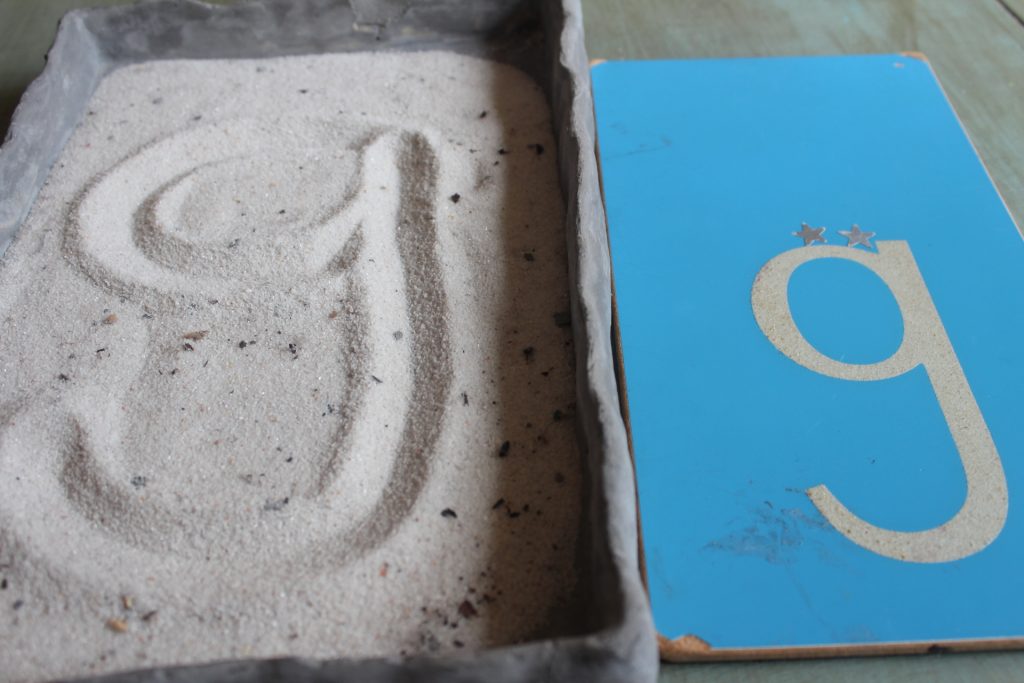
Fill the bottom of a tray with sand/flour/salt or even shaving cream. Give your child the visual letter card to copy and invite them to draw it in the tray with their finger.
Benefits include: Development of fine motor skills, hand eye co-ordination, development of the sense of touch, letter recognition and letter formation.
Every child is different, but we recommend introducing tactile letter formation activities such as these around 4 years of age. After your child has mastered shapes.

Did you know if we mix yellow and red we can make orange? This week we are going to have fun with an egg shell painting and explore mixing yellow and red to make orange together (see Art activity)
This week we are having fine-motor shape fun as we recap circles, squares and triangles. Last week we shared a fun play-dough recipe for our speckled frogs and this week we are going to re-use our play-dough for some more fine motor fun was we work on our shapes together.
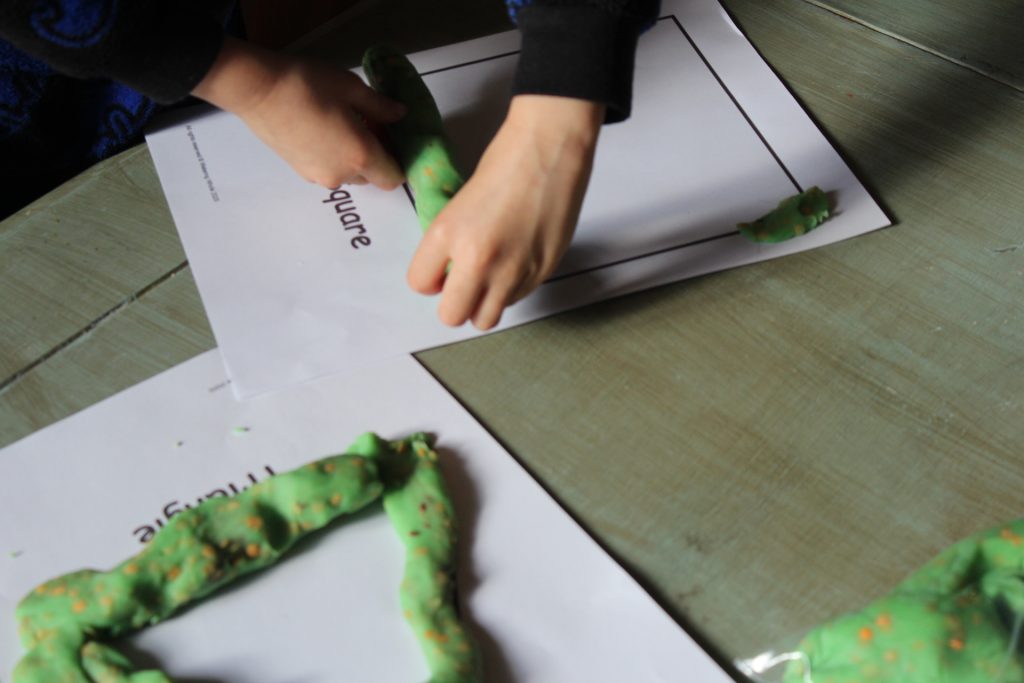
Directions: print out or draw the shapes. Use your play-dough or some pipe cleaners to create the same shapes on top of your paper. Explore your shapes together counting the sides of a square and the number of corners, then compare it to a triangle and a circle which has no corners.
Benefits include: introducing the concepts of sides, angles, and corners, early maths skills, strengthening of hand and finger muscles, hands-on, tactile learning of shape formations (precursor to letter and number formations).
Did you know ….playful rhyming, songs and games are one of the first steps to reading readiness?
Research shows, there is a strong correlation between a young child’s ability to rhyme and their later ability to read.
Join teacher Inger this week as she shares some fun songs and rhymes with you all about our feathered friends.
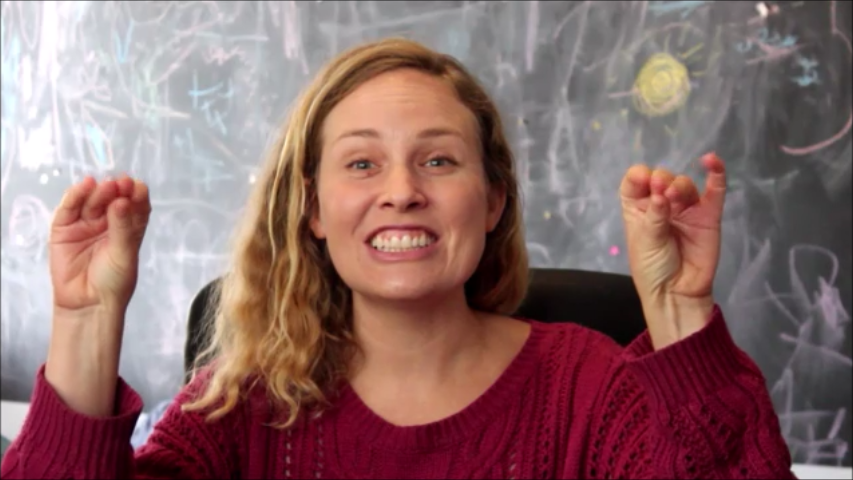

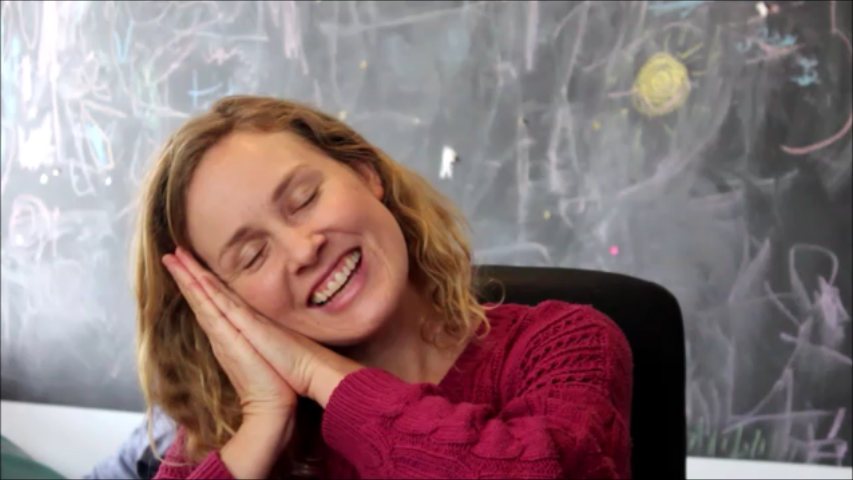

Did you know there are many different kinds of birds, most can fly, but some (like penguins and ostriches) can not. One thing that all birds do have in common is that they lay eggs!
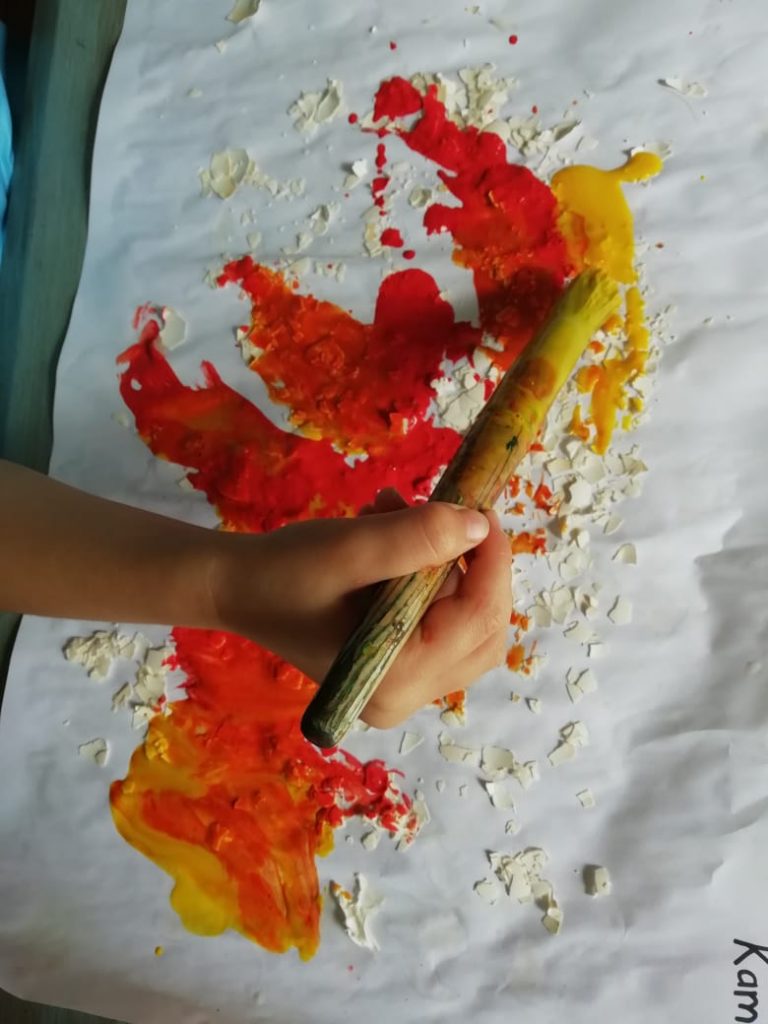
This week we are exploring the colour orange by mixing yellow and red and we are also crushing egg shells to make our own art.
Benefits include: Fine motor development through crushing egg shells and painting, learning about colours and colour mixing, developing curiosity and creativity.
Instructions
Rinse and then bake your egg shells for 20min at about 100 degrees.
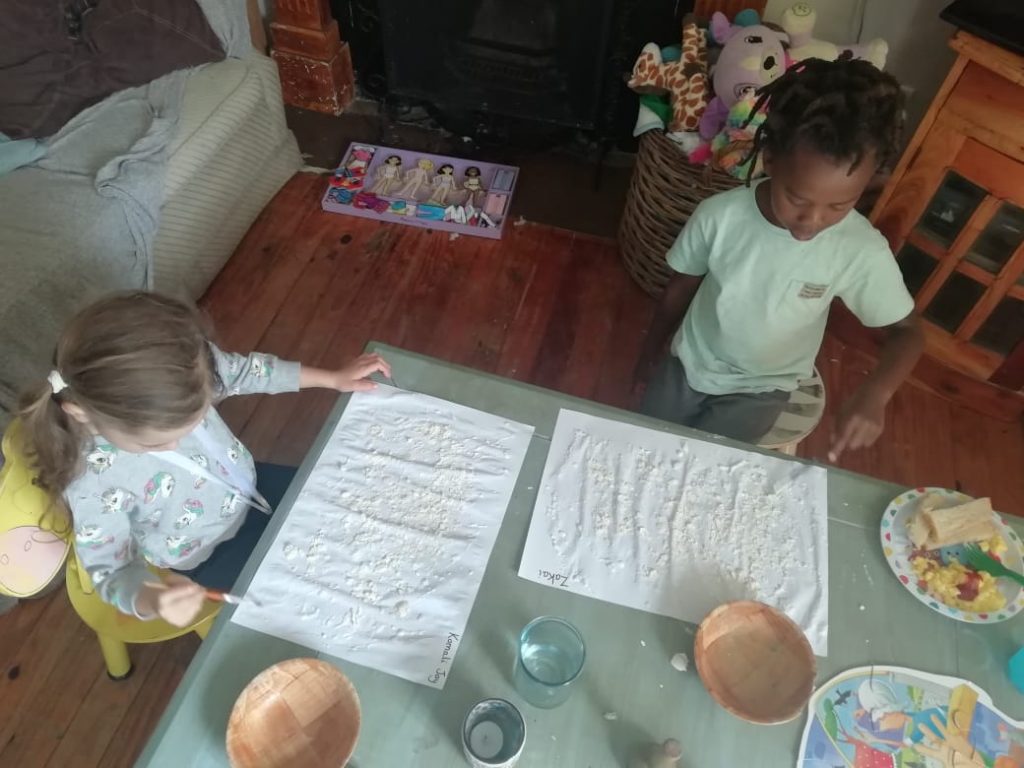
Invite your child to crush the egg shells with a pestle and mortar or something similar, paint a piece of paper with glue and then sprinkle on the egg shells.
Once this is dry invite your child to paint over the egg shells with yellow and red paint.

Talk about the texture of the paper and the colours that you see!
Counting, recognising numbers and one-to-one correspondence are all important skills needed for maths readiness.
For younger children having fun reciting numbers aloud through songs and play is the best way to start laying the foundation for maths readiness.
For older children, this week, we have created a fun printable for matching the number of eggs in a nest to the corresponding numeral.
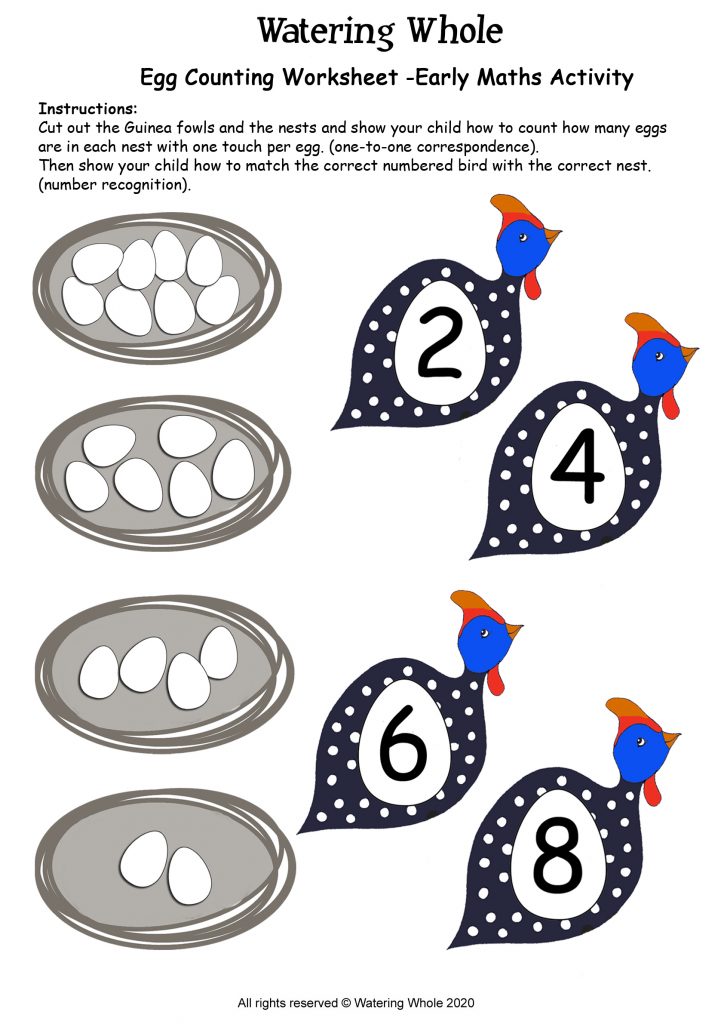
Directions:
Print out the nests and birds from the printable provided for you on the resource page.
Cut out the birds and the nests and show your child how to count how many eggs are in each nest with one touch (one-to-one correspondence).
Show your child how to match the correct numbered bird with the correct nest (number recognition).
For older children you can see if they can figure out the object of the game on their own by saying, “I see birds with numbers on them and I see nests with different amounts of eggs in them…I wonder how we are supposed to play this game?”


Let’s spend some time sitting outdoors in our garden this week listening to and watching birds together. For those who don’t have a garden, try to find a window for your little one to be able to watch out and listen for birds from.
Take this moment as a contraction/breathing out and going inward together. Learning to pause and be still is a wonderful tool for self-regulation and focus that takes time to develop.

Being fully present outdoors/in nature is also a wonderful way to regulate the body and mind.
You can start off by explaining that birds can be hard to see, but are much easier to hear. Close your eyes together and listen. Where is the sound coming from? …and what different kinds of birds can you hear?
By teaching children to listen to and differentiate between different bird songs you will help to develop their hearing and focused listening skills.
Can we imitate the songs of different birds? This is wonderful for language development and expressive communication skills.
Now let’s count how many different kinds of birds we can see; we can also look for birds’ nests in our trees and even look out for bird poop!
We have been seeing so many birds in our garden since lock-down, including an eagle flying overhead!… And Go-Away birds eating our granadilla leaves! I am amazed how much the children have been enjoying learning about birds and their ability to differentiate between different birds and bird sounds.
Now, every day we spend time in the garden we are listening to bird song and spotting different birds around us.
If your child gets really invested in birdwatching you may consider purchasing a poster like the one featured below and learn the names of all of the different birds too:

https://www.penguinrandomhouse.co.za/book/poster-birds-southern-africa/9781775843795
We can learn all about birds with this fun video too:

You can’t have a bird themed week without making something full of yummy fruit and seeds…so for this week we are making Homemade Crunchy Granola (– We have loved doing this with some of your little ones in the past, as it’s a favourite!)
Ingredients:
½ cup honey
½ cup natural maple syrup
4 cups rolled oats
½ roughly chopped almonds
½ cup sunflower seeds
1 cup dried fruit such as apricots, raisins, apples
1 tsp dried cinnamon
Directions:
Preheat the oven to 180 degrees
Warm honey and syrup on stove
Combine all of the dry ingredients in a large bowl
Add the warmed honey and maple syrup and mix
Spread the mixture onto a lined baking tray and bake for about 15mins, stirring occasionally to make sure nothing burns
Each week we start off our Intellidance classes with a BrainDance. Developed by Anne Green Gilbert, BrainDance is comprised of eight developmental movement patterns that warm up the body and integrate the brain namely:
•Breath: Breath not only provides our brain and body with the oxygen it needs to fully function, but can also ease feelings of stress and anxiety.
•Tactile: Touch develops body awareness and sensory integration.
•Core-Distal: Body extension and contraction strengthens children’s connection with core muscles for proper body alignment.
•Head-Tail: Moving the head and pelvis develops awareness of the relationship to each other and increases spinal mobility.
•Upper/Lower: Young children need to organize upper and lower body independently before they can synchronize them together.
•Body Side: Moving body sides balances the body so that both right and left sides have equal strength and mobility.
•Cross Lateral: Cross-body movements help the left and right hemispheres of your child’s brain connect and co-ordinate which is important for developing full cognitive function.
•Vestibular: The vestibular system helps humans analyze the relationship between body parts and their movements in relation to each other, as well as the relationship between the body and the general space. This is important for developing body awareness and balance responses as well as processing sensory input.
This week we will be doing a bird themed BrainDance with Teaching Inger…..

Let’s get out our binoculars and explore all of the birds around us….
Breath – Can you hear that?….Let’s breathe in and hoot like an owl three times.
Tactile – I see a guinea fowl, with its beautiful spotted feathers….Can you pat and brush your feathers all over your body?
Core Distal – Can we make our bodies small like a tiny egg…oh look, the baby birds are hatching. Can you crack out of your egg and become a big baby bird?
Head-tail – Slowly turn your head from side to side like an owl, what about pecking your head up and down like a chicken? Can you wiggle your tail feathers?
Upper – Move your wings like an eagle flying.
Lower – Run around like an ostrich.
Body-Side – Let’s try balancing on one leg like a pink flamingo, now the other… Now waddle like a duck from side to side.
Cross lateral – Can you make some chicken wings with me? One wing at a time ….Show me your pointy elbow, lets tap tap tap our elbow wing, show me your other pointy elbow let’s tap tap tap the other side.
Vestibular – Can we whoosh our upper body flying and soaring up and down and side to side? Can you spin around like a bird feather twirling in the sky?
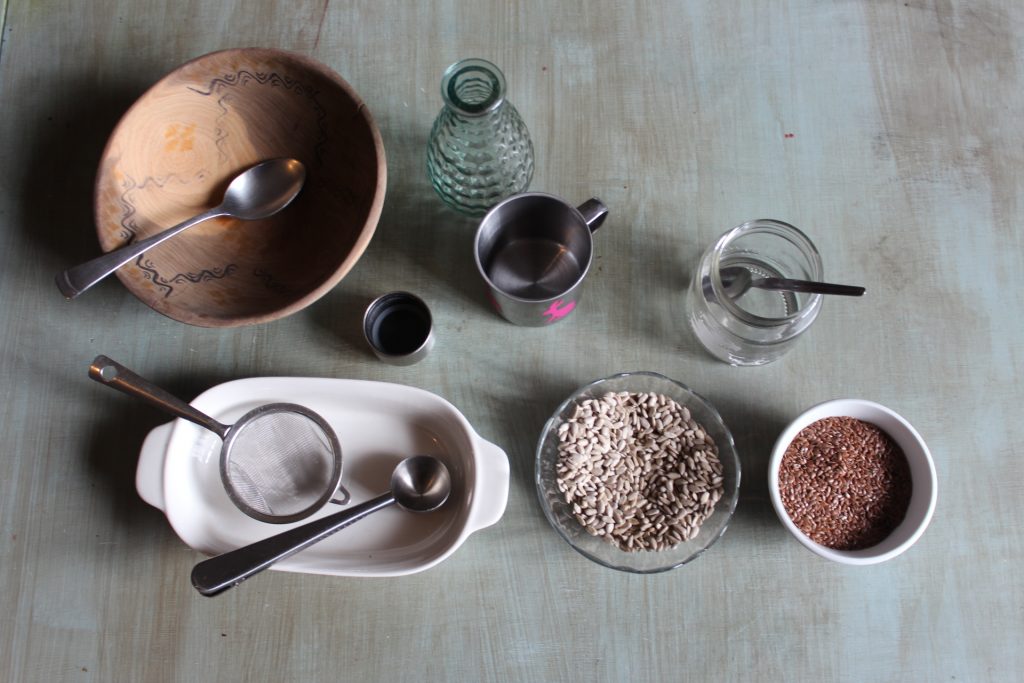
Set-up a space with measuring cups, spoons, small bowls, funnels, etc…
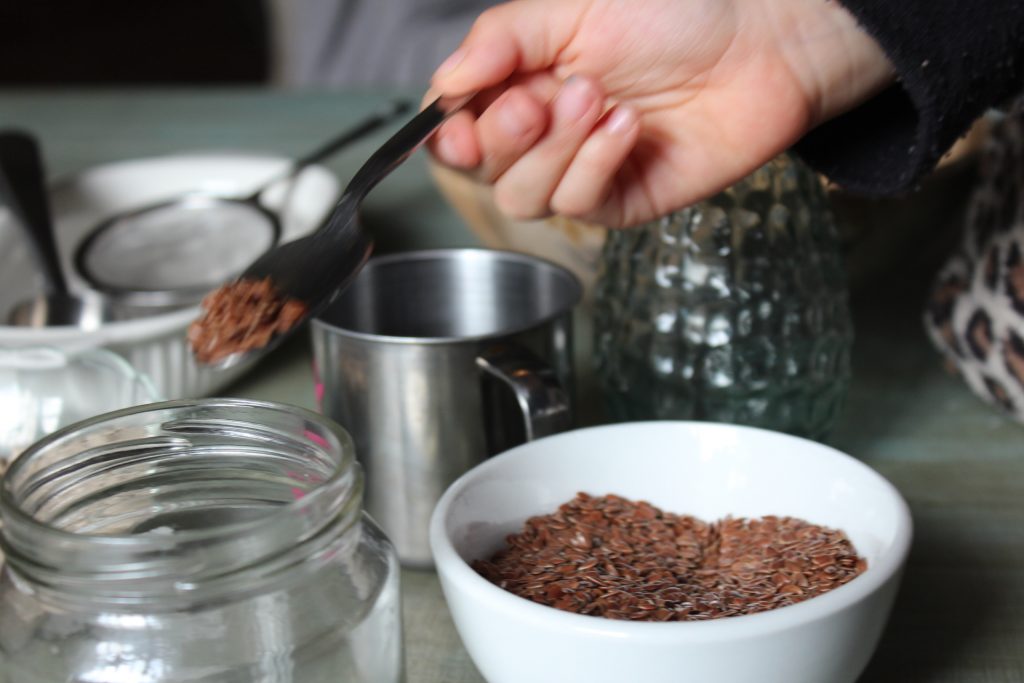
Invite your child to pour, measure, spoon sunflower/bird seeds for some wonderful fine-motor, sensory exploration and play.
These can even be put outside to feed the birds if you have a garden!
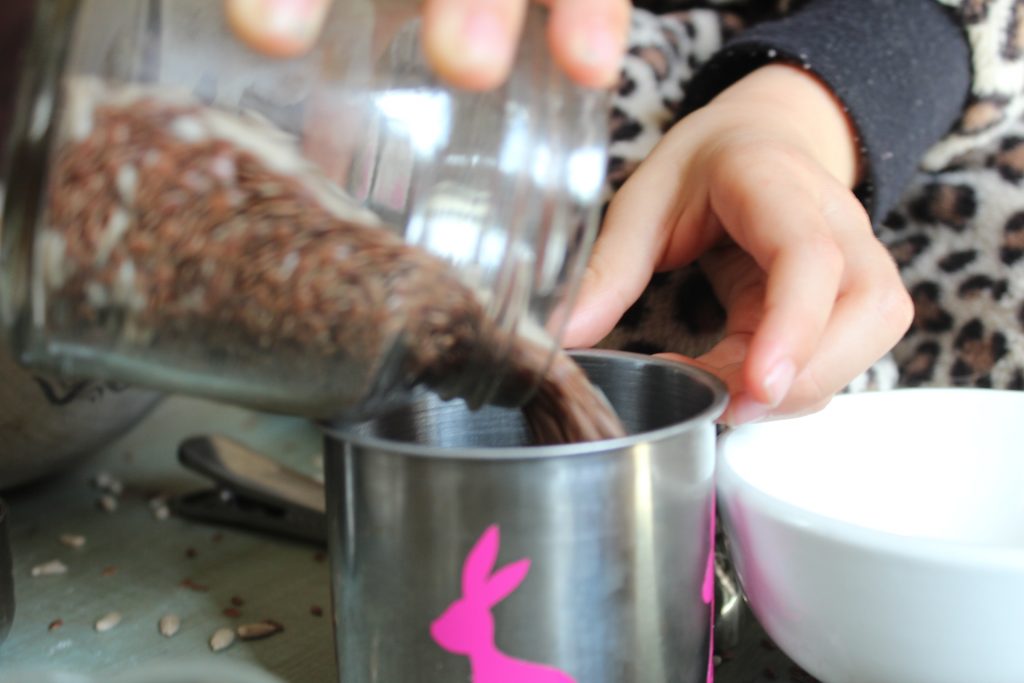
Transferring activities form part of Montessori practical life exercises. Benefits include: developing fine motor control particularly spooning and pouring, increased concentration skills and hand-eye coordination.
© 2012-2026 Watering Whole Holistic Preschool All Rights Reserved