The Adventures of the Leaping Frog
Let’s explore all the ways we can move just like frogs…..

Let’s explore all the ways we can move just like frogs…..
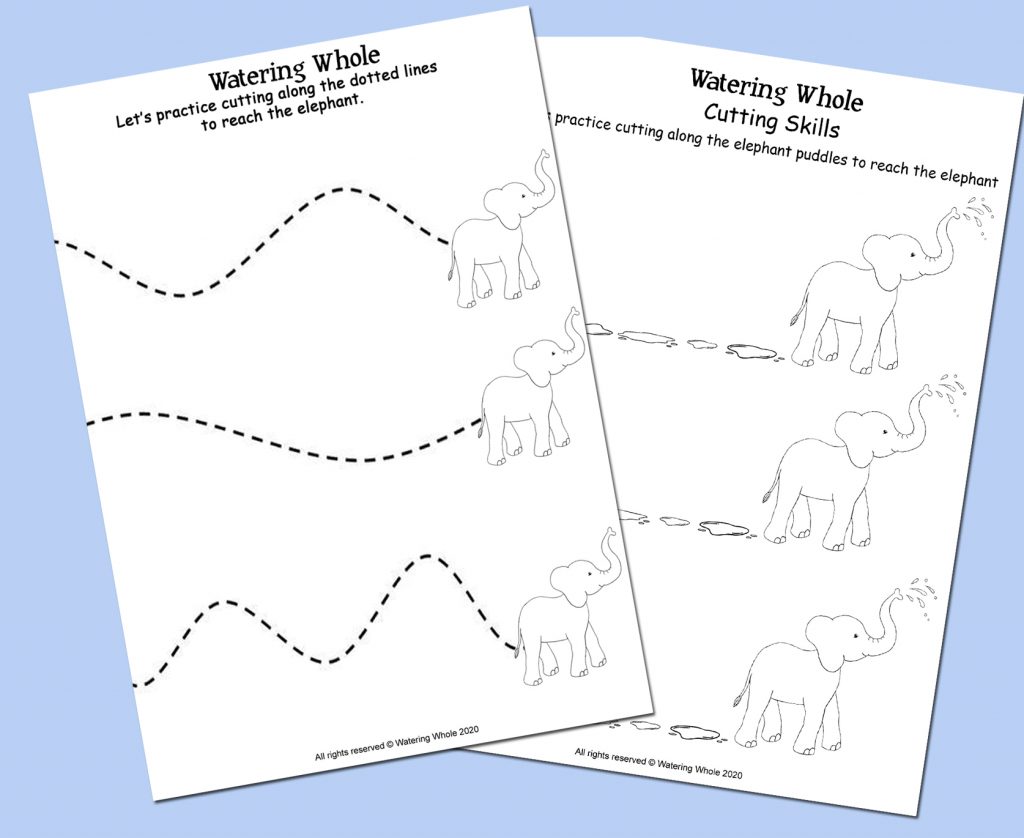
We have been working with our illustrator on some wonderful cutting activities for this week. Have fun cutting along the straight puddles and squiggly paths made by the elephant!
Cutting Benefits include: Focus and concentration, strengthening of hand muscles, hand eye co-ordination, bilateral co-ordination from holding scissors in one hand and paper in the other.
Cutting skills take time and practice to develop. Children should start showing some competence around 3-4 years, but these skills are generally only fully developed around 6 years of age.
For the younger children, tearing paper and cutting dough using blunts scissors is a wonderful way to start working on these skills.
Each child is different and will develop at their own pace, but here are some guidelines of what to expect depending on their age:
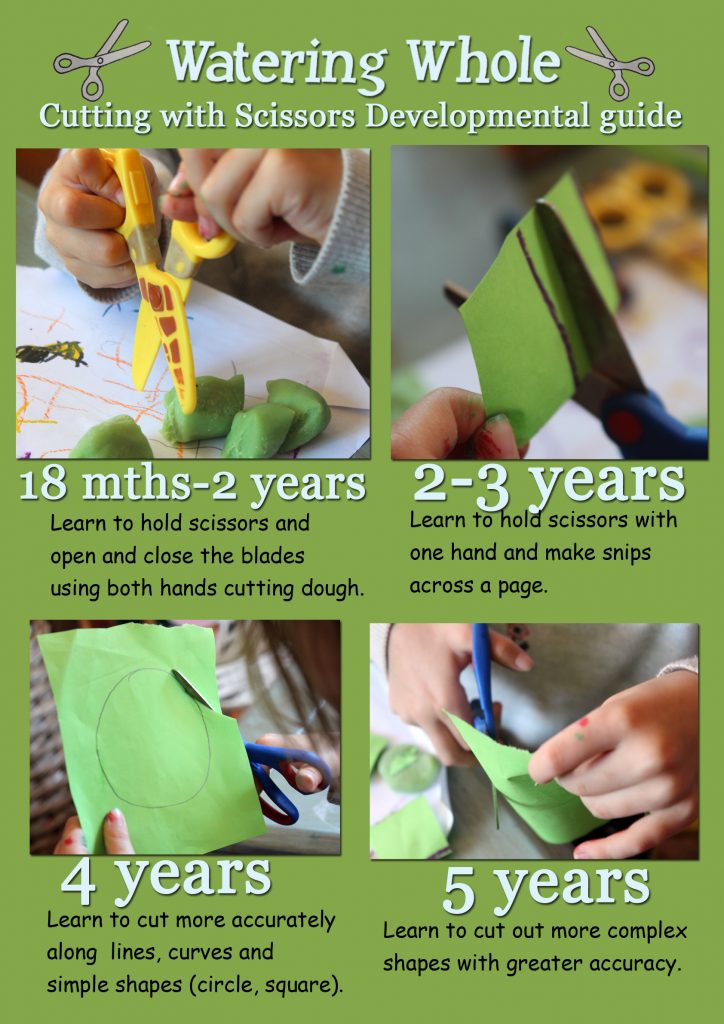
18 months: Ripping and play dough play. Children exercise their tripod grasp as they grip the paper to rip it. Ripping also requires children to move their hands in opposite directions at the same time which helps develop bilateral co-ordination skills.
2 years old: Once your child has learnt to hold scissors, open and close the blades using both hands and has spent time cutting dough and tearing paper with hands, they can start to master opening and closing the scissors with one hand and move on to making small snips on the paper.
3 years old: Remember to always encourage a “thumbs up” position while holding the scissors. Help them learn to hold scissors with one hand and make snips on the paper while moving the scissors forward across a page. Make this easier by keeping the size of the page they are cutting small. Cutting will not be accurate or be a continuous forward motion.
4 years old: Your child will learn to cut more accurately (near to the line). Work on cutting along a straight line at first, and then a curved line and then different simple shapes (circle, square).
5 years old: Your child will learn to cut out more complex shapes with greater accuracy.
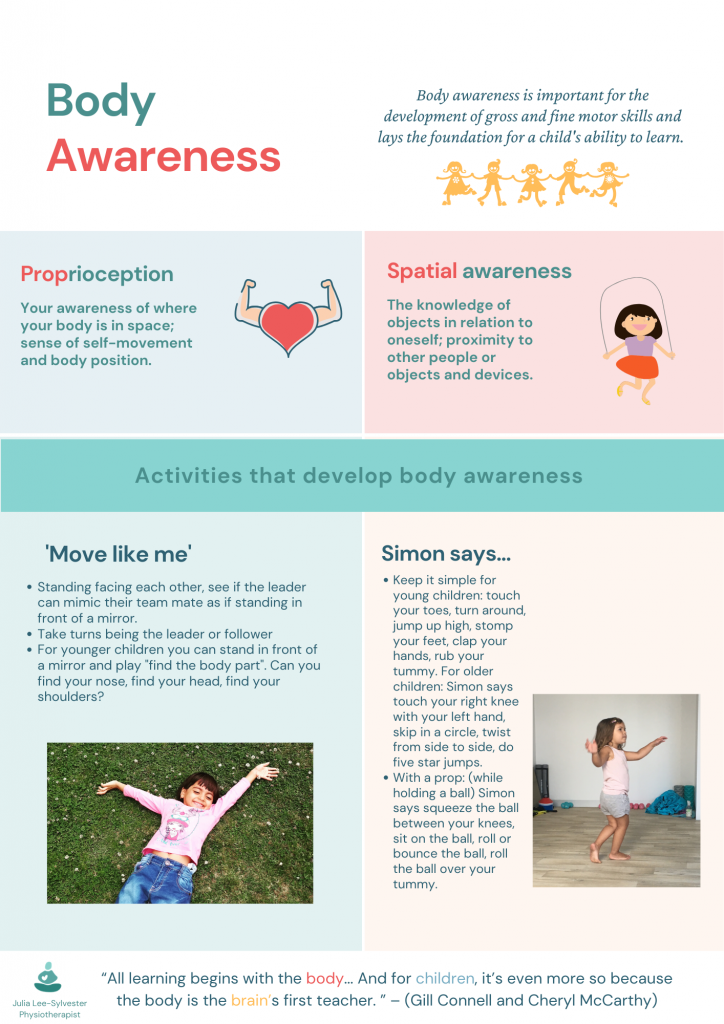

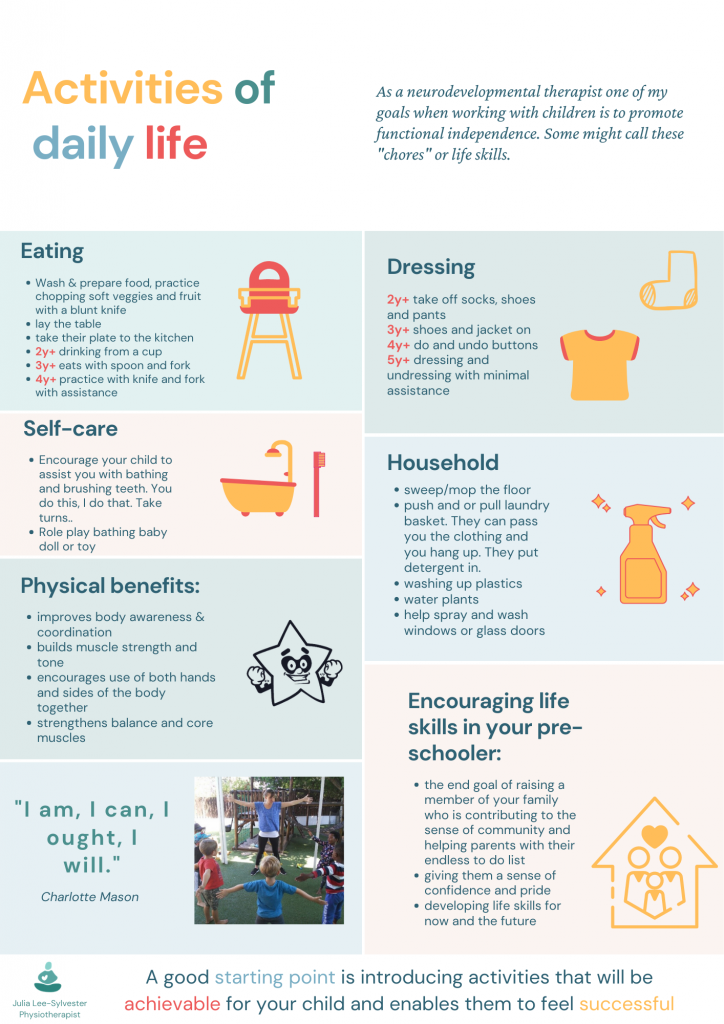
Enlisting our children’s help around the house when it comes to cleaning up after themselves and other chores, is not only a wonderful life skill, but has many gross motor and fine motor benefits too!
This week Physiotherapist Julia Lee-Sylvester is sharing some wonderful “activities of daily life” for your @home gross motor and fine motor programme.
“As a neurodevelopmental therapist, one of my goals when working with children is to promote functional independence. Some might call these chores or life skills.
It’s good to be mindful that when we do include our kids in an activity, the process is more important than the result and there will likely be lots of mess 😉
Parents, for some their child helping them with chores or activities of daily life can be triggering and result in anxiety for you or your child. We can’t and do not need to include or stimulate them all at time!
When I find myself getting frustrated I stop and ask myself (after a few deep breaths); what would I like to be the memory we make here? Perfectly baked and iced cupcakes but an incredibly stressed out mom or an average batch of cupcakes that look like a dogs breakfast but a fun time had by all? Take the pressure off, especially during these difficult times we find ourselves in currently.” – Julia
Watering Whole @Home Curriculum Week 3
Gross Motor and Fine Motor with Teacher Julia: This week Julia is sharing a fun gross motor obstacle course with a fine motor component too, as well as some @home-friendly fine motor games to play this week. |
“As a paediatric physiotherapist I absolutely LOVE obstacle courses!
They provide an exciting opportunity to cater to your child’s sensory and motor needs while having fun. In addition to the sensory and physical benefits from doing the obstacle course your child may get a chance to practice valuable skills such as following simple to complex instructions, sequencing, short term memory, motor planning and imaginative play.
I hope you have fun thinking and planning WITH your little ones to see what you can add to your #lockdownobstaclecourse. Please feel free to tag @wateringwhole and @juliaphysio if you upload your videos on Facebook 🙂
Tips for setting up:
Try to include a variety of age appropriate activities that include some or all of the following:
Can you hop around the room like a bunny with two feet together? This is wonderful gross motor work that helps to develop balance and core muscle strength!
Here is a fun Bunny Hop prewriting printable we have created for you. Invite your child to hop with the bunny on the picture by tracing the curved lines with their finger.

© 2012-2026 Watering Whole Holistic Preschool All Rights Reserved