Category Archives: COVID-19 specific support and materials

EQ: External COVID-19 specific support and materials.

Here we have collected some age appropriate information, stories and resources from external websites that we have found really helpful for our own family. If you have any resources that you have used that have been helpful please to share with us here.

Here is some wonderful advice from Becky Bailey, the creator of our beloved FEELING BUDDIES and SAFE SPACE that we have utilised here at the Watering Whole:

“Kids don’t say, “Beloved parent, I’m having difficulty in my daily life. I don’t fully understand what’s happening, I miss my friends, I’m afraid someone I know is going to die and it feels like life will never be normal again.” Instead, they throw tantrums, become clingy, sulk, backtalk, refuse to do anything you ask, wet the bed, pick fights with siblings and suddenly forget how to do basic tasks they mastered years ago.

Whew! Let’s step back, take a few deep breaths and learn a little about your child’s brain: Safety is the brain’s most basic need, followed closely by connection. When we feel unsafe or disconnected, our brains downshift from the higher centers responsible for learning and problem solving, to the lower reactionary centers. That’s why all those challenging behaviors are popping up, and why a minor frustration is now Titanic in size.

We can help children (and ourselves) by creating a sense of safety, connecting, and cultivating a new sense of normal with these five tips:

  • Our calm increases children’s calm.
  • You are the most important Safe Place for your child.
  • The brain requires safety and connection.
  • Be intentional about cultivating both.
  • Create a “new normal” together using routines and play.
  • Provide helpful ways for children to contribute every day.
  • Consciously choose to see the best in others and circumstances.” – Becky Bailey

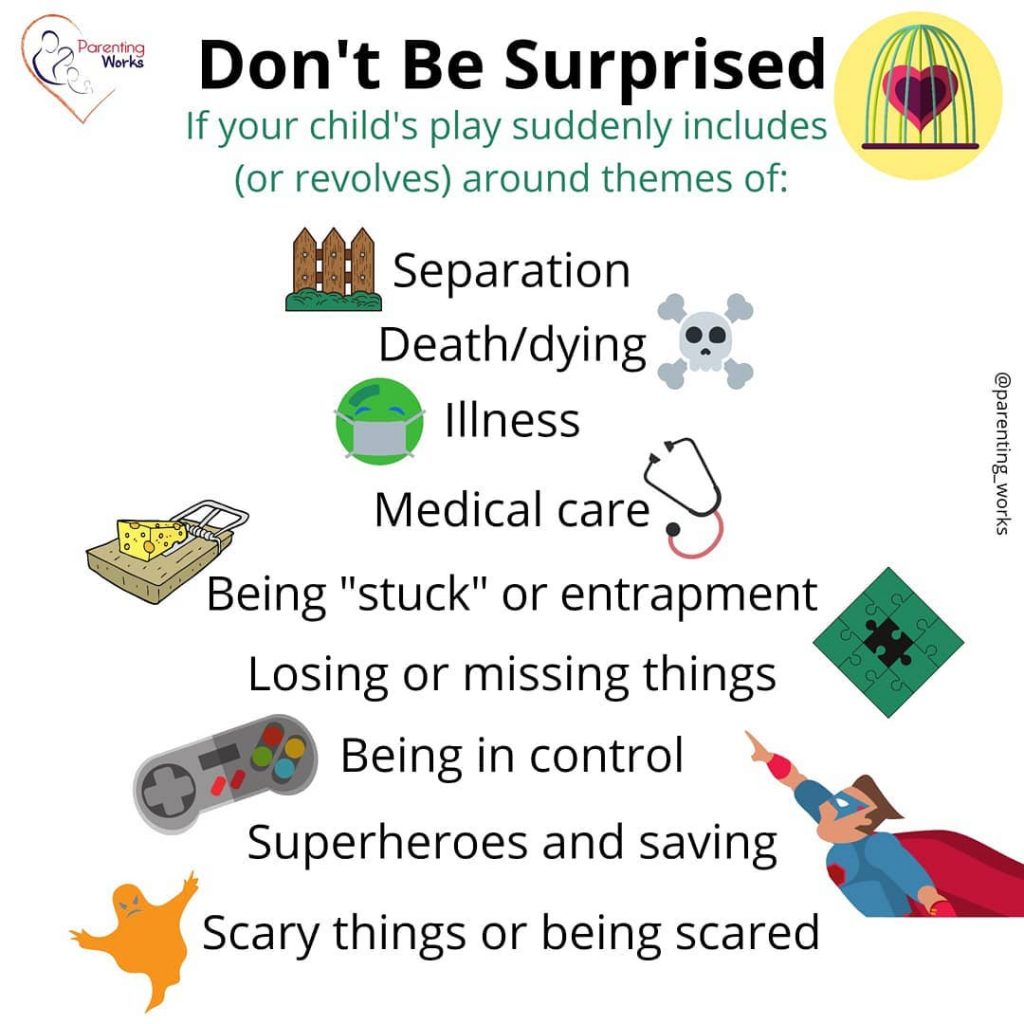
You may also notice your child’s play changing….we certainly have!

I love this post from @parentingworks which says :

You’ve heard me say many times that play is children’s work. That means you may see some good psychological work as they play during these unprecedented times of quarantine. This means they are processing and integrating their experiences–trying to understand the new normal. In other words, don’t be afraid if you see these themes in their play. This is a sign that they are doing something healthy and important! So, lean in and let them play through the uncertainty, confusion, and change.
Additional External supports you can download:


Coronavirus is a big word – Social Story – From Conscious Discipline

Child friendly Explanation of the Coronavirus – Story From https://www.mindheart.co/

Talking about CORONA VIRUS-19 with young children – from UNICEF

These resources can be read to your child to start up a conversation around COVID-19 and their feelings. Remember to be honest and factual, honour the feelings that your child may have such as fear, sadness, anger saying, “Yes I understand you are feeling that way. It’s okay to feel that way”, but then also always reassure your child that they are safe and that home and family are their safe place!

Gross Motor Work with Teacher Julia:

“As a paediatric physiotherapist I absolutely LOVE obstacle courses!

They provide an exciting opportunity to cater to your child’s sensory and motor needs while having fun. In addition to the sensory and physical benefits from doing the obstacle course your child may get a chance to practice valuable skills such as following simple to complex instructions, sequencing, short term memory, motor planning and imaginative play.

I hope you have fun thinking and planning WITH your little ones to see what you can add to your #lockdownobstaclecourse. Please feel free to tag @wateringwhole and @juliaphysio if you upload your videos on Facebook 🙂

Tips for setting up:
Try to include a variety of age appropriate activities that include some or all of the following:

  • weight bearing on arms through to the shoulder girdle
  • jumping or crashing/bashing
  • something that will get their heart rate up for some cardiovascular work
  • ball skills
  • balance
  • bilateral coordination, which is using the two sides of your body together in a controlled way (skipping, galloping, riding a bike).
  • be aware of your child’s unique sensory profile. Do they need deep pressure? Pulling, pushing something heavy? Do they need vestibular (movement) input? running, spinning, jumping, rolling? Are they nervous of fast movement and /or heights? Then lets rather ease into it slowly and start with something they are comfortable with.
  • be aware of your child’s play style and incorporate it to motivate them. Do they enjoy deeply imaginative play? Let’s save your friends from the lava monster! Or do they rather enjoy competing with themselves and want to make it a time trial..
  • something I often include in our obstacle courses at the Watering Whole is a fine motor component. Keep an eye out for next week’s post where I will explore some @home-friendly fine motor games to include in your obstacle course or to just do when you need a quiet activity to keep your littles ones stimulated.”

Life Skills and EQ: Creating a Visual Routine.


Last week in EQ we talked a little about the ways in which we can emotionally help our children cope during this extremely difficult time. One of the most important ways we can do that is by creating a “new normal” together using routines and play:

“The brain thrives on predictable patterns. Our daily and weekly patterns have been turned upside down without warning. Creating a new normal begins with a new daily routine. Families with older children can work together to co-create your new daily schedule (co-creating gives children a way to exert some control over the situation), while parents of younger children will create the schedule for them. Plan it, draw it, label it, post it somewhere obvious and refer to it often so children know what to expect.” – from the creator of the feeling buddies

At Watering Whole preschool we have a daily visual routine that the children like to check to see what activities are happening that day. Sometimes if a child is missing home we will take the child to look at the visual routine to see what activity is next and also when they will be going home again. This gives them reassurance and creates a sense of predictability and safety.


Let’s make a visual routine together this week as part of our life skills and EQ work. You have the option of drawing up some images yourselves or you could use the printables from this week’s resources provided to print out, colour in, cut out and stick up your own routine.

Download WWHP Visual Routine here.


Special thanks goes to Kjersti Smith from https://www.kjerstismith.com/ who has illustrated this visual schedule especially for the Watering Whole!

An example of a routine could be:

Wake up,
get dressed,
eat breakfast
stretch/exercise/play
Exploration/Learning Time
Snack
Free play
Lunch
Quiet time/nap time/reading time (read books together)
Project Time/guided play (art work/baking/puzzles/printables/science and nature etc)
Family Time (Dance party, sports, concert/show, etc)
Dinner Time
Bath Time and Brush Teeth
Story Time
Bed Time
 
Did you know Visual schedules will decrease anxiety, reduce conflict and power struggles, help build executive functions like prioritisations, flexibility and time management. 

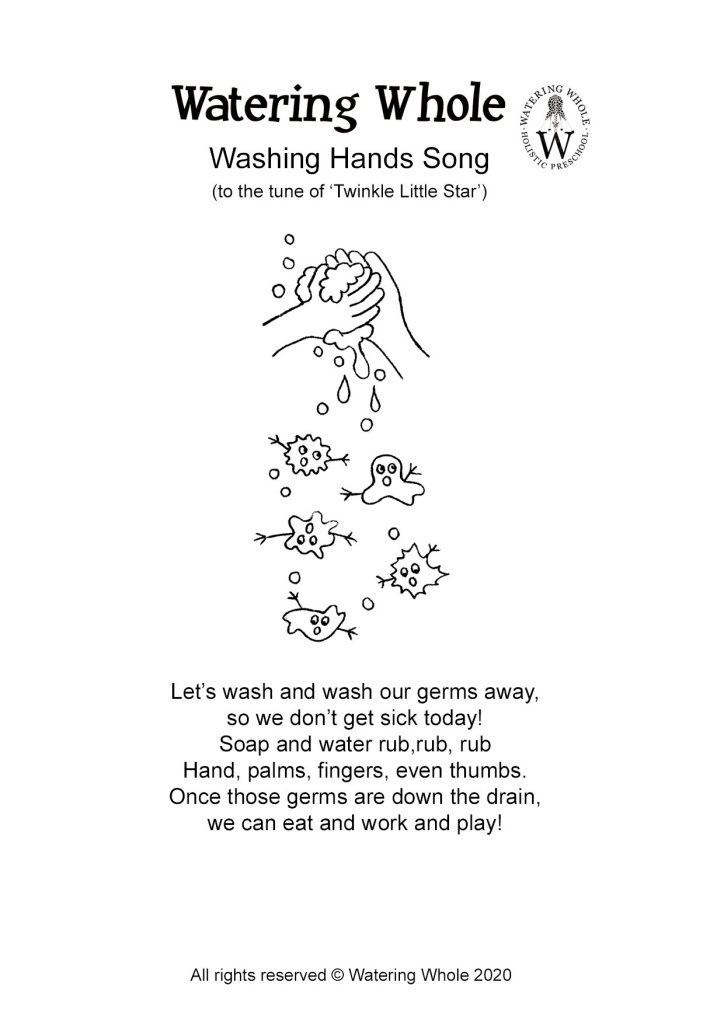
Hand Washing Song

As you all know hand washing has become highlighted of late as one of the main ways to stop the spread of the Coronavirus (and other germs too).

We at the Watering Whole have our very own song written by teacher Inger that we use when we are washing our hands. It’s 20 seconds long which is the recommended time to wash, it is sung to the familiar tune of Twinkle Twinkle little star, and the song lyrics remind us to wash each part of our hands so we are thorough!

Download Hand Washing song as PDF here